You Can Learn How To Sand Cast Metal And Make Almost Any Kind Of Part You Want.
The secret is having the practical know how and the special DIY foundry knowledge.
The Process Begins With The Foundry Basics:
- Sand –
- Scrap Metal –
- Stock-Ingots –
- Furnace & Tools –
- Plus the all important practical Know How – Gained as you learn, explore, and practice your technique.
Once you understand the intricate foundry process detail and get to learn the proven success methods, you’ll be on the way to metal casting success.
You could, of course, go out and do it all on your own, it can be done, but you’ll advance much quicker with less frustration with the right kind of help and guidance, and that’s what we are here for, to help teach you (Without blinding you with science or industry jargon) about the lost tradition of foundry skills & the techniques of the old time foundry metal craft.
There was a time when the art of foundry was common knowledge, but now, in this cyber world of today, it’s almost obsolete… but not to the foundry practitioners of today, some amazing results are possible as you’ll see below, and throughout this web site.
We’ve heard it said by so many people, “they lament the demise of the old style skilled tradesman”… The kind of chap who could fix or make almost anything, and often these very same people possess the knowledge to cast beautiful things in metal. You could be one of them.
Metal Casting Success Is There For Almost Anyone Who Is Willing Give It A Try?
Imagine… If you’re into creating, building, and making things, you’ll love the practical challenge, this is your kind of world, DIY metal casting, and if you are serious about learning new practical skills, we can show you stuff that could keep you occupied for many years.
Since 2003 we’ve been sharing practical down to earth foundry knowledge, helping thousands of people from all walks of life, across more than forty seven countries around the globe to learn the art of metal casting.
We want to share with you how to set up your own hobby foundry in your own backyard workshop, we’ll show you what equipment & tools you’ll need… gear and tools that you can easily build your self…
- You don’t have to be a genius, nor do you need a rocket science degree, all you need is the desire & passion for your hobby, plus some practical ability, which you probably have, otherwise, you wouldn’t be reading this page… would you?
- The basic skills & methods we’ll explain to you have been successfully employed by people who have never before tried their hand at metal casting.
Once you understand the basics of this metal craft, the sky is the limit.
You probably already know of people who get a kick out of showing you the “toys” they have acquired with their money, but I can tell you now, nothing comes close to the personal reward, admiration, and satisfaction you’ll enjoy when showing others the special things you’ve made using your own creative skills & practical talents… it beats the “look at me” money folks hands down every time.
Perhaps you’ve stopped somewhere to admire a beautiful bronze sculpture, or artworks in metal, and you’ve had a light bulb moment, that sudden bright idea or thought, when you suddenly had a vision about something that you would like to cast in metal.
Well Don’t Just dream – Just Do it… you can turn your dream into a metal casting reality, (Within reason) there’s nothing stopping you at all.
Many people get hooked on metal casting… I’m not sure what it is, but there is something magic about watching molten metal flow into a sand mould… but you’ll understand more about that when you actually do it.
So, What Could You Make?
All kinds of things. The only limiting factor is the amount of:
- Skill –
- Imagination –
- Determination –
- And Passion you have –
Foundry work is fairly basic, the process begins with a timber, foam, plastic, or even metal pattern. (Or maybe even a 3D printed pattern) The pattern is used to make the cavity in a two-part sand mould, the sand is rammed firmly around the pattern, the pattern is then rapped & carefully with drawn from the sand, the molten metal (Melted in a simple furnace) is poured into the mould cavity and allowed to solidify…. And bingo, you now have your bright new metal casting.
Simply remove the flashings & roughness left from sand casting, thendrill it, mill it, turn it, buff it or paint it, and there’s your fantastic shiny new part.
The more you learn about metal casting, the better your skills will become, the more things you’ll be able to make.
When your skill level reaches a certain level, you’ll want to try your hand at more advanced projects – a lot of people become involved with foundry work because they want to make special things such as inlet manifolds for motorcycle or car engines, you may think that is a little ambitious and above the DIY league, well I am happy to say that it isn’t. Sure, it will require a good understanding of the pattern making and all of the foundry processes, but it is indeed doable, and we’ll show you with the photos below.
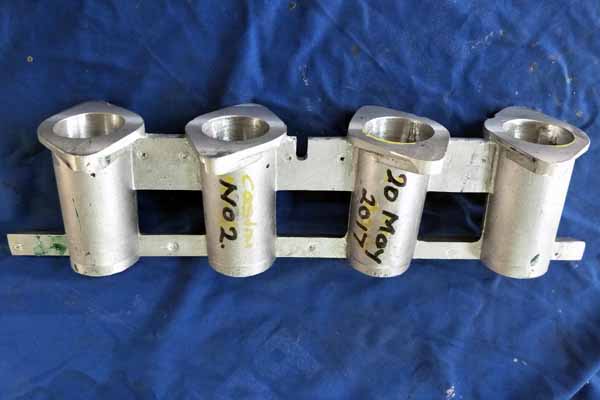
A Cast Aluminium Inlet Manifold Project In The Development Stage.
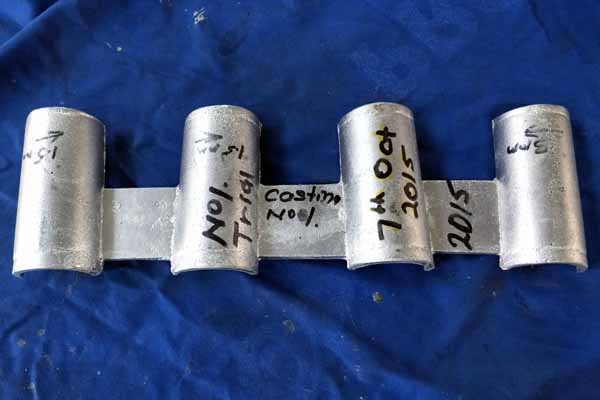
The manifold castings above and below, illustrate the very long drawn out process of designing from scratch, a carburettor inlet manifold. Take note of the dates recorded on the castings – the first trial casting No 1 – 7th Oct 2015 – trial Casting No 2 – 20th May 2017. A long time apart, but we are nearing the time when the final casting is going to be be made.
This a totally DIY casting project undertaken with a fairly basic back yard metal casting foundry – This should be food for thought for you.
Practical minded people begin casting metal for all kinds of different reasons, the trigger for most could be a desire to remake an obsolete part for a restoration project, and when you think about it, it makes sense, because if the part in question was originally produced by the sand casting method, then nine times out of ten the same part can be reproduced again using the same method in your hobby foundry.
The kind of knowledge we share in our ebooks… explaining the practical methods to create castings from aluminium or bronze.
The metal casting process is not difficult to learn, and once you understand, you are really only limited by your skill and imagination.
The foundry moulding medium can be of green sand (Traditional Moulding Medium) or silicate sand (Resin and Binder mix).
When a pattern is rammed with prepared green sand in a mould box, the fine grains of sand bond together & retain the exact shape of the pattern, when the pattern is rapped & removed from the sand mould, a replica shaped cavity remains which is where the molten metal is poured.
Silicate sand can also be used for making moulds and cores, green sand is a good choice to begin with. Many art casting studios still use green sand for their foundry work, you can even make and prepare it your self.
Silica sand requires the purchase of chemicals, (resin and hardener) but the problem for the hobby worker is that the actual quantity of chemical required is small, so, the purchase of a twenty litre (5 gal) drum could mean considerable expense, and the large quantity of chemical may go off before you get to use it all, but the silicate system is great for making sand moulds and cores.
Aluminium, because of it’s relatively low melting temperature (740C) is a great way to begin metal casting, aluminium scrap is readily available and ideal for breaking down and melting and pouring good quality ingots which you will use to make good quality metal castings.
Ideas For Building Your Aluminium Scrap Pile:
- Engine inlet manifolds,
- Discarded aluminium cylinder heads,
- Cast aluminium cover plates,
- Gear Box Bell housings, etc.
Good scrap metal can be found in many places, keep your eye out, and collect your scrap anywhere at anytime.
As a hobby foundry worker it is in your own interest to build your own Gas Fired Furnace. The Metal Casting Made Easy ebook provides all of the instructions with measurements supplied in both imperial and metric.
The furnace interior is lined with a high temperature resistant refractory cement which can be obtained from a foundry supply warehouse, you can also make your own home made refractory, (an old time recipe is included in the ebooks) but the home brew refractory might not last as long as the proven commercial variety, but it is a low-cost way to begin.
The whole foundry process is exciting, prepare the sand mould, melt the metal in the crucible, degas and remove the dross, and it’s ready to pour.
The pot of molten metal is carefully removed from the furnace with a pair of special lifting tongs and placed into a well designed hand pouring shank, wearing the proper safety gear, take hold of the pouring shank that cradles the pot, and pour a strong constant stream of molten metal into the down sprue of the sand mould.
When the metal in the mould has cooled down, it’s time to pull the moulds apart to reveal your bright, shiny and brand new…
- Art metal casting –
- Vintage car or motorcycle part,
- Reproduction part for an old machine of some kind.
- Parts for classic car’s built in the fifties and sixties.
To be honest, the things that you could make with metal casting are truly endless, the writer has been casting for twenty five years, and produced all kinds of things during that period.
With a bit knowledge and practice it wont be long before you’ll be able to start making your own unique, quality castings…
The castings in the picture below are fresh out of the green sand mould, they are aluminium hinges for a British car built in the sixties. This type of product is very easy to replicate and reproduce with sand casting method… the original door hinges were die cast.

Once the casting has cooled, the gates – runners & sprues are removed, the castings are then prepared for the machining and finishing operations.
Machining of the castings is done with a small bench lathe, plus a few special DIY tooling & jigs to hold each hinge during machining and threading cutting operation.
Cast aluminium pressure vessels requires tight, porous free metal, there are some techniques that can be employed to cast high quality porous free cylinders, these techniques are also explained in the ebooks.
The slave cylinder below would sell for about $110.00, imagine if you could start producing products like this to sell on ebay, forums, and other auction sites, could be a nice little earner for you… There are people doing this and making quite a bit of money.
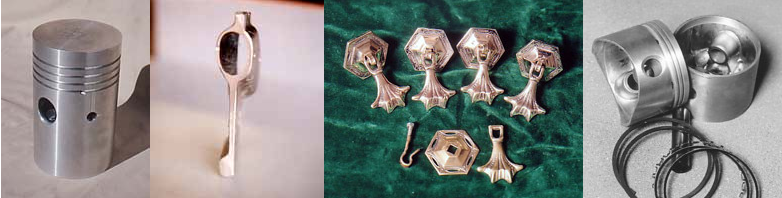
Above From left:
A 7KG aluminium tractor piston | Section Of Water Passage Way | Antique Bronze Door Handles | Aluminum Pistons.
The items above were all produced with the equipment and tools outlined in the ebook package.
The ebooks available on this web site have helped countless people how to cast:
- veteran/vintage/classic car parts-
- veteran/vintage/classic motor cycle parts-
- All types of antique items-
- Beautiful art castings –
- Unique sculptures –
- Special property name plates –
- The weird and the unusual –
- And many odd parts for special projects.
The possibilities are endless once you understand the basic methods and techniques of metal casting.
Please be aware that handling molten metal is dangerous, unsafe practices can cause personal injuries.
The metal casting process requires that great care should be exercised at all times, the hobby foundry is not the place to consume alcohol, for being stupid, careless behaviour, metal casting is a serious business – Be responsible – TAKE CARE.
Ok my friend, you’ve read this far… I know you want to know more about this ancient metal craft?
Maybe you are just beginning to explore metal casting as a hobby? The best way to begin your learning is to download the sample ebook,
The ebook is a shortened version of the 98 page Metal Casting Made Easy ebook, peruse through twenty randomly chosen pages… a summary of the main ebook which is also accompanied by The Design Of Gates And Risers, plus all of the other valuable bonus ebooks that make up the package described on The Library Page.
The complete ebook package can be purchased and downloaded direct from this web site. The Package Provides A Huge Amount Of Hobby Foundry Info.
Now, before you do anything else, we want you to take a moment to download your free ebook. Just fill out the form below and click the submit button, don’t worry, your details are safe with us, we hate spam just as much as you do, we will never ever share your details with other parties.
Just fill out your first name & a valid email address. (Note: Invalid email addresses are trashed by the server.)
Begin your journey now, grab your sample Metal Casting ebook, as well as the amazing Old Time Hints & Formula ebook.
A Thank You For Dropping By Gift…
Just pop your details in the box below & wait a few moments for an email to arrive at your inbox with your special download links.
Check your inbox shortly for the email message which will include your download links. If the email appears to not arrive, check your junk mail folder
Take a moment to listen to a short mp3 streaming audio audio message from Col, the practical Australian hobby foundry ebook author.
The audio runs for 1min 44 seconds, and has a short buffering time. To listen, click on the white triangle player button on the left side. Don’t forget to turn your speakers on.
If there is something we really enjoy and that hearing from our customers from around the world, many are eager to inform us about the success they are having. The email below arrived recently from a happy customer, we’re pretty thrilled to know that Keith is enjoying real success with the hobby foundry knowledge he has gained from our ebooks.
Just imagine… you could also enjoy the same kind of metal casting success.
Hi Col. Thank you for checking in on me. Also thanks for the ezine. Good stuff. I actually purchased several books on home foundries and I am pleased to write that I literally have my furnace behind me, here in my room with a 100 watt light inside of it to slow cure it. You see, I just cast the refractory this weekend. I am very happy with the way it has turned out. Your design is the best of all of the designs I have found put together. Plus I added a few of my own ideas along the way. I will send you a picture of it when it is done. Thanks again. Keith Taylor. California USA.